

Halfway up a steep street in Margate, in a residential area a short walk from the town centre, is a nondescript building.
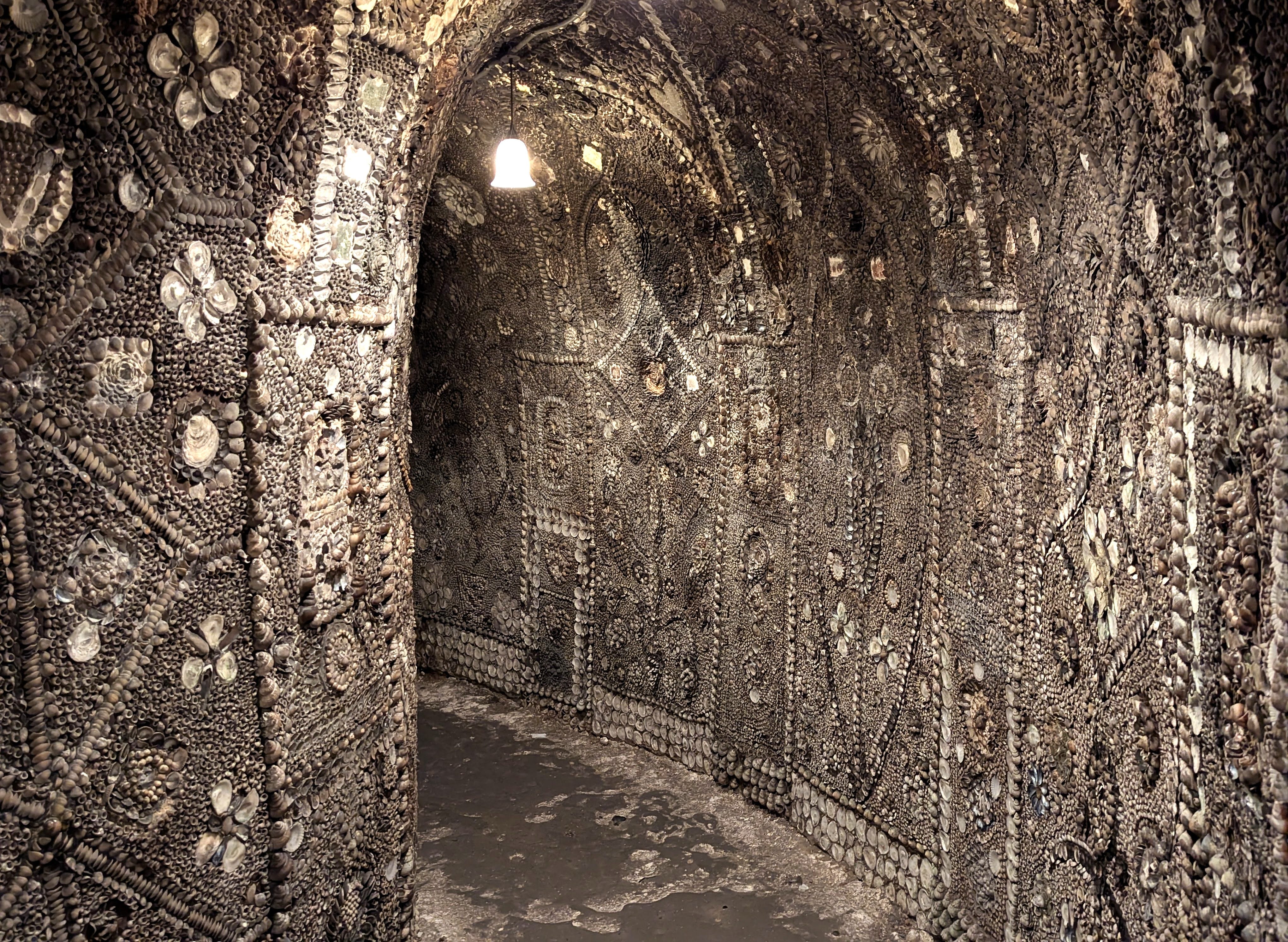
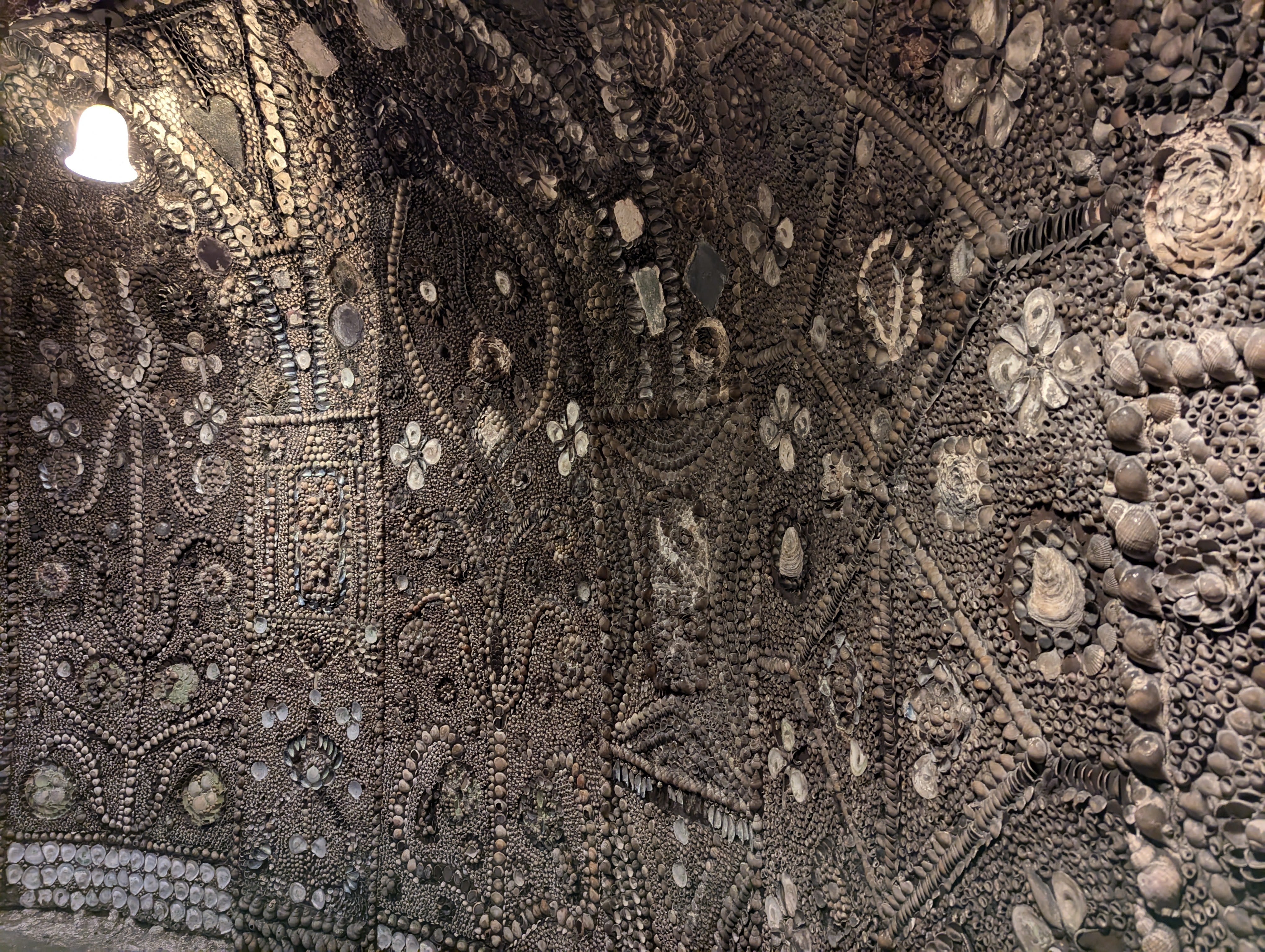
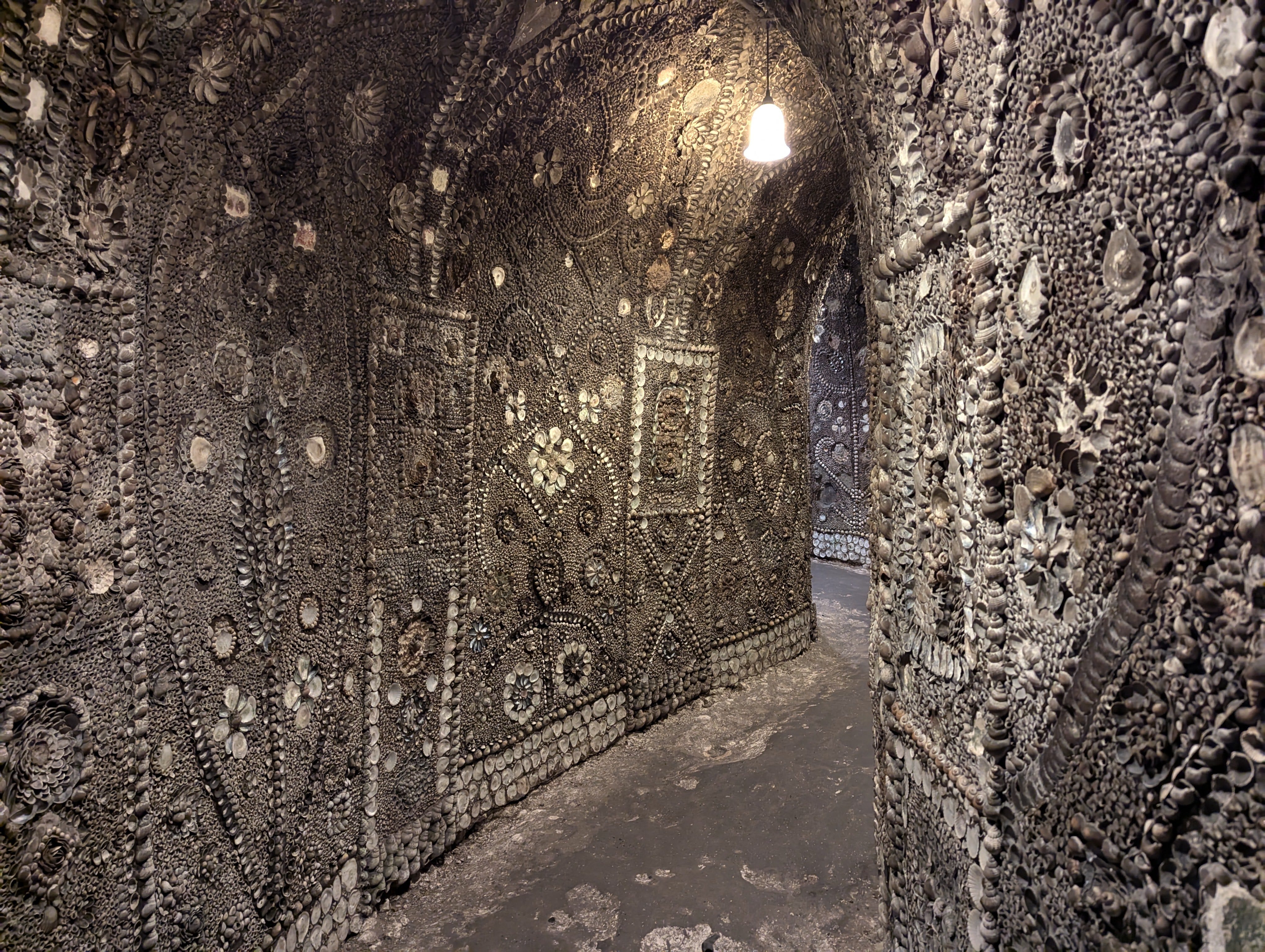
Walk in, pay a small fee, and head down. You’ll find yourself in a labyrinthine passage, dimly lit. It covers over 2,000 square feet. And around you - all around you, covering every inch of wall and ceiling - are shells.
Pressed into strange patterns - swirls and stars, lines and geometrics. Some look like plants, others hearts.
More than four and a half million of them.
This is Margate’s Shell Grotto. Ever since it was discovered nearly 200 years ago, it has been the centre of mystery and intrigue.
Because nobody has been able to say for certain who made it, when, or why.
A disputed discovery story
Before the 1830s, there’s no mention of the Shell Grotto anywhere. It simply doesn’t exist in the record.
At this time, Margate was a seaside town on the rise. The tourism trade was beginning to boom, travellers coming down from London, which was just a few hours away.
A man named James Newlove bought a cottage in the town, and set about improving his land.
He was shovelling away turf, building a duck pond for his garden, when his spade suddenly broke through to- nothing. James realised he was standing on a cavern, hidden beneath his garden.
So he fetched his son, and slowly lowered him down into the dark void, a candle in hand (health and safety be damned). Quite quickly, it was clear that this was no ordinary cave.
The candlelight revealed all those millions of shells covering the walls and ceilings, arranged in mysterious patterns and mosaics.
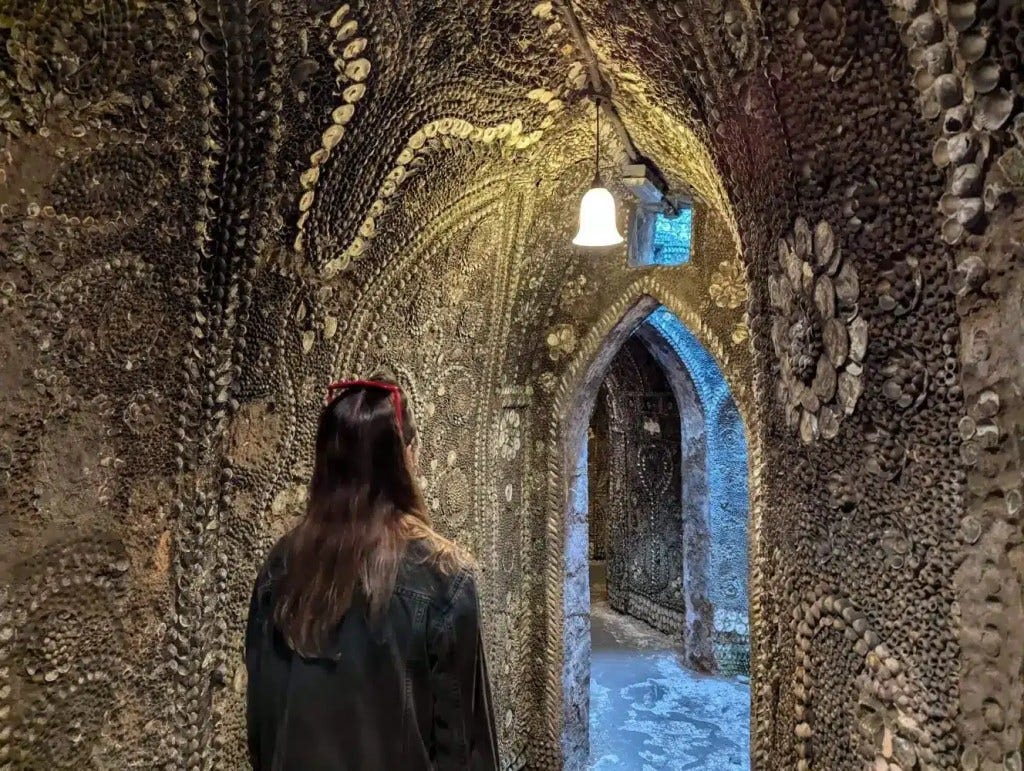
Nothing is quite certain with the Shell Grotto, even the story of how it was discovered.
Years later, James’ own daughter Frances, by then the owner of the site, contradicted the story I told above. She claimed that her brother had found it all by himself, and had been too afraid to tell his father: together they had explored it all, before James ever knew about the cave.
Either way, within a few years, Newlove had opened the Grotto up to tourists, and was charging entry.
It was a convenient discovery. An increasing number of tourists were visiting the town and this was, after all, England. It rained a lot. An undercover tourist attraction was always going to succeed, especially when surrounded in mystery.
The Newlove’s early guardianship of the Grotto makes you wince, though. For decades, gas lamps were used to light up the caves for paying punters, which has discoloured the shell walls.
They also cut through one of the Shell Grotto’s roof, in order to make space for an extension for a girls school they ran above ground on the site.
Ancient origins?
Quite quickly, the Grotto’s owners emphasised its unknowability, suggesting it was created in ancient times.
It certainly captures the imagination to think of an ancient Thanet, an unknown civilisation working together to create this astonishing underground tapestry, traipsing down under firelight to worship their gods.
The designs of the mosaics have added to theories that the Grotto was built by an ancient civilisation.
Though the whole place feels spiritual at its core, there’s no overt Christian symbolism, which was viewed by many as a sign the Grotto came before the dominance of Christianity.
Instead, most of the mosaics are quite abstract and have been described as similar to, for example, Ancient Egyptian designs.
But at the time the Grotto was becoming popular, it was relatively commonplace for rich people to design things to look older than they really were.
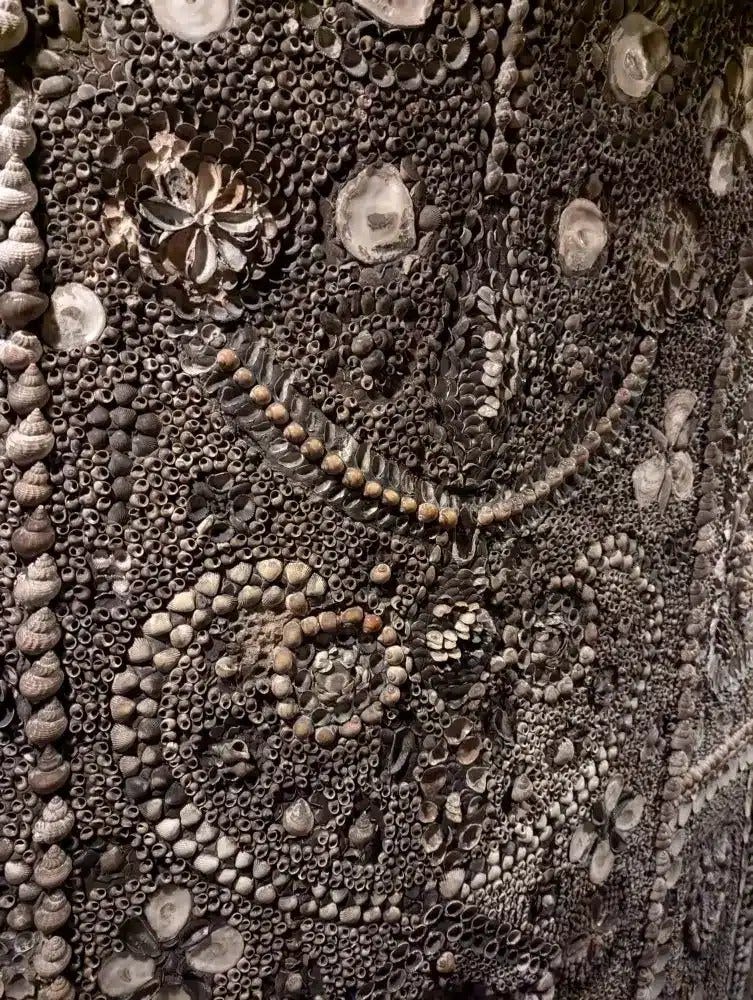
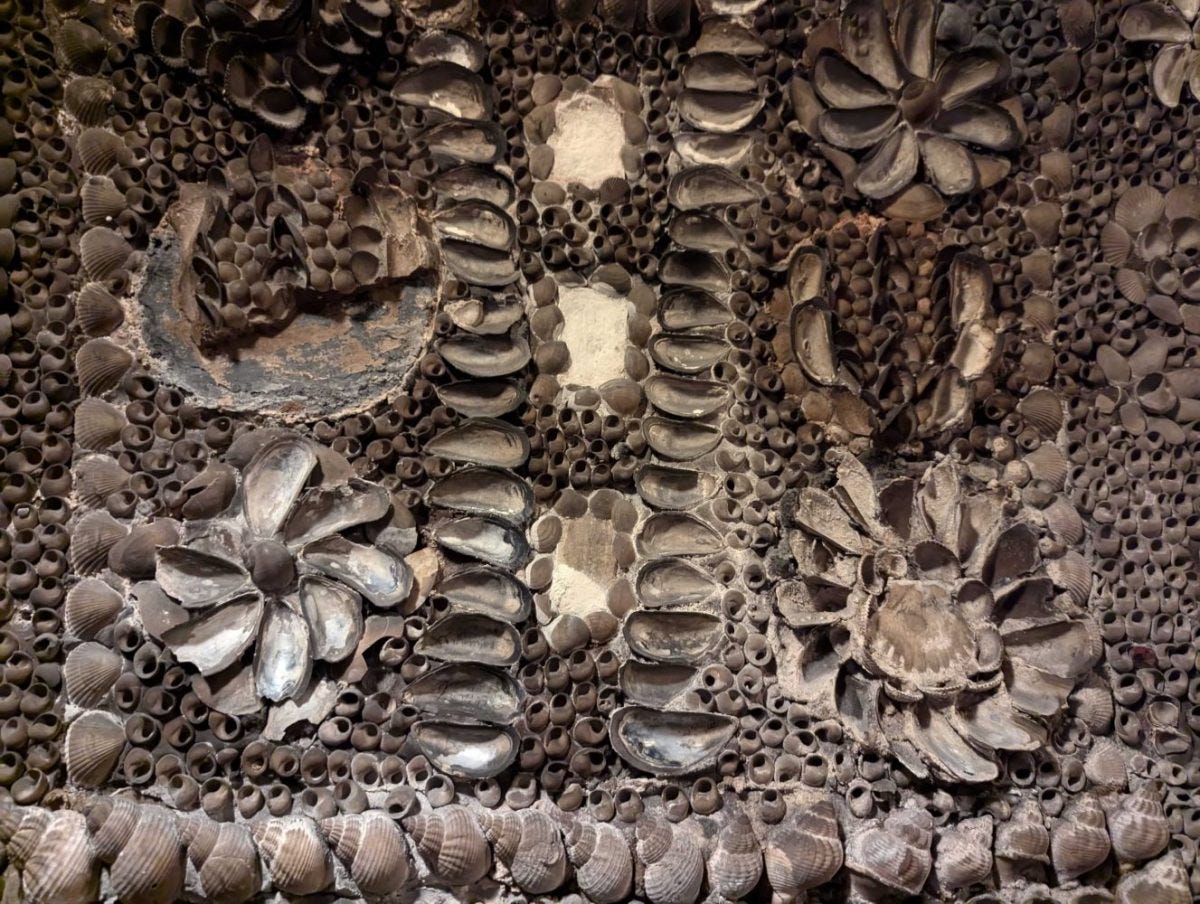
Patterns on the walls of the Shell Grotto
Among the theories that have been put forward are that it was created by the Romans, possibly as a Mithraic Temple - a male-only cult, who would meet in underground temples. Others pose that it was even older, possibly created by the ancient seafaring Phoenicians, who may have visited the country in the first millennium BCE.
The idea of the Shell Grotto being ancient site gained popularity after a little known author named Marie Corelli published an article in Temple Bar magazine, in 1885.
Just a year later, Corelli would publish her first novel. This would propel her into fame, making her one of the age’s eminent writers, read by millions, including Queen Victoria herself.

Her articles, including that on the Grotto, were republished in a book, bringing her account to a much wider audience.
So her account would have had a huge impact in the fame of the Grotto, as well as the theories people would begin to believe about it. When she isn’t taking swipes at the town of Margate (“not exactly high-class”, “plebeian”, “the disadvantage of being at over-popular Margate”), she is praising what she sees as ancient craftsmanship:
“If the curious and beautiful subterranean temple, of which I am about to speak, existed anywhere but at Margate, it would certainly be acknowledged as one of the wonders of the world, which it undoubtedly is.”
The land the Grotto was on was known as ‘The Dane’, possibly an allusion to Viking raids that had ravaged England’s South Coast. To Corelli, this was a sign that it was a Scandinavian place of worship from those times, and should be called the “Shell Tomb of the Vikings”.
Sadly, there are a few things that suggest that the Grotto isn’t anywhere near this old. One of these is the shells themselves. Of the 4.6 million shells that make up the caves, almost all are native to the British Isles.
But a few are from much further afield. Queen conch shells in the Altar chamber originate from the Caribbean. So for the Grotto to be truly ancient, somebody would have had to find a way to the Caribbean - or, somehow, for it to have washed up on Thanet’s shore by chance.
The arches in the Grotto also suggest a not-ancient origin, being in a Gothic style which was particularly popular in the 14th century. However, others have argued that this style of arch was used not for stylistic purposes, but just to reduce the risk of it collapsing.
Or a modern mystery?
Just because it’s most likely not ancient, it doesn’t mean there’s no mystery.
For a long time, the most likely explanation was seen as a folly. These were buildings with no particular purpose, often made to look much older than they really are, or as a show of wealth. Follies were indeed popular at the time – and shell structures like this were, too. In fact, according to English Home around 200 shell grottos still exist in the UK. One can be found at Hampton Court House, for example.
A couple of things work against this theory, though. Follies were a statement, a show of means and culture. But nobody knew that the Shell Grotto was there until it was found by accident in the 19th century. Why would somebody go through the effort of building it, and not tell anybody? And why would nobody remember it?
To collect so many shells would surely have involved a great number of people. But when the Shell Grotto was discovered, it was a surprise to everybody.
Another thing working against this theory is the location of the Grotto. Follies of this type were usually built on a rich person’s estate. But as far as is known, the Grotto never formed part of somebody’s estate, and instead fell under farmland.
Others lay it at the door of the Knights Templar - a Christian military order with allegiance to the Pope.
Through extensive research, Mick Twyman of the Margate Historical Society found that on the arrival of each Spring equinox, sunlight enters the grotto through a dome with a circular opening. As the seasons change, the amount of light grows larger, shining lights over parts of the shells. At the arrival of the Summer solstice, the light seems to shine an egg like shape in the belly of a mosaic snake.
To Twyman, the Grotto likely came from the 12th century, and were Templar in origin.
It’s a fascinating finding for sure. But the lack of obvious Christian symbols makes the idea that it was created by the Knights Templar questionable. And people do tend to stick the Templar title onto anything old-looking and unknown in origin - especially since Dan Brown.
Margate’s other underground wonders
This embellishment, mystery and uncertainty comes with the territory. Margate knew that mystery sells tickets
Ten minutes away, you can still visit Margate Cave: chalk mines from the late 17th or early 18th century.
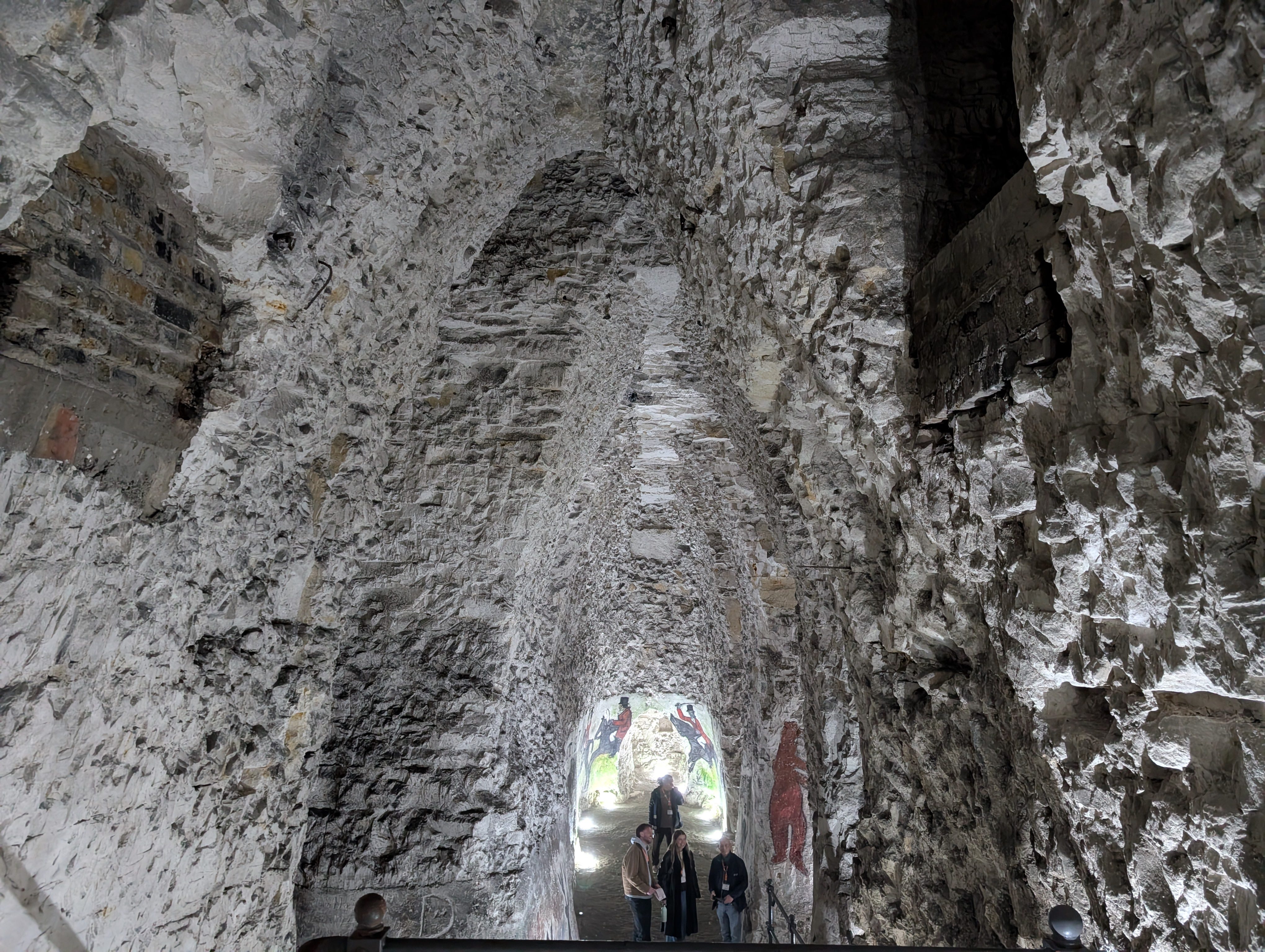
These caves were rediscovered in 1798 by the owner, a man named Francis Forster, who had local artists paint the walls.
By the mid-1800s, the caves’ new owner John Norwood opened the caves up to the public. He renamed them ‘Vortigern Caves’, claiming they dated to 454 AD, charging punters to view these ‘ancient’ underground passages.
Also less known is that a few decades earlier, a second shell grotto had been found near Margate High Street.
A contemporary news article from 1804 says:
“There is at Margate, although known to only a very few persons, a curious grotto, concerning the construction and real date of which nothing is certainly known. It is on the premises and behind the house of Mr Oldfield, and has a door which opens towards the sea, behind which is another, glazed with painted glass, on which are various well-executed emblematical representations, with two armorial bearings, and an inscription with the name of a Dutch lady and the date of 1612. Whether this is the date of its erection or not cannot precisely be told.
So unlike the famous Shell Grotto, this one had a date attached to it - 1612, albeit the source that mentions it (a paper by Kent Archaeology) acknowledges that we don’t know what this date meant.
It also no longer exists, the shells having been removed, and is now the ordinary cellar of a private home.
A possible answer: a hole in the ground
The Shell Grotto is a beautiful, spiritual place. The level of effort and craftmanship that has gone into the millions of shells, forming mosaics in underground passages, are remarkable. It’s quite unlike anywhere I’ve ever been.
All of this will remain true regardless of when it’s from, and who built it.
But it can’t be denied that its mystique is one of its main draws. The possibility, however slim, that it could be thousands of years old. That’s what made it famous. That’s why thousands of Victorians flocked to it; perhaps why people still do.
So there’s an argument that it’s best that we just never know. At any rate, the Shell Grotto themselves have said that to carbon date it would be too disruptive, and is superseded by conservation priorities.
That being said, there is a theory which seems, to me at least, the most likely.
In 2005, a man named R.F LeGear comprehensively surveyed the Grotto for the Kent Archaeological Society, but used a novel technique. He ignored the shells entirely, and surveyed the site as if it were an excavated void, comparing it to other manmade chalk caves in the surrounding area.
For centuries, people in Kent would dig what are known as ‘deneholes’. These are essentially chalk mines, dug with a small hole then opening up into a wider chamber, where chalk could be excavated and hauled up using rope. They were usually found on farmland so the chalk be spread out on the field.
LeGear found that the structure of the Shell Grotto is very similar to that of deneholes across Kent. Not only did it have the tell-tale narrow shaft leading to underground passages, but the length of the passages were also a clue.
In a denehole, everything you cut has to be dragged back to the shaft and hauled straight up on a rope. The further out you dig, the more the rope drags at the bottom of the shaft, and eventually it simply becomes too much work to go any further. That gives you a fairly predictable limit: chambers of roughly three to five metres.
LeGear found that each passage in the Shell Grotto runs to about that length, before turning sharply, after which they carry on with smoother curves.
This, to LeGear, suggested two phases. First an ordinary medieval (or possibly even older) denehole, dug as far as a rope would allow and then abandoned. Then, much later, somebody reopened it and kept digging, moving the spoil out by wheelbarrow rather than hauling it up the shaft: a method that only came into common use in chalk mines of this kind in the seventeenth century.
That second phase is what gave the Grotto its long curving passages. And at some point after that, for some reason (spiritually? art? or, in a more cynical view, to bring in tourists?), somebody decorated them with shells. (If of interest, you can read his analysis here)
This would make the denehole extremely old. They were dug from before the Roman Conquest, all the way up to the Middle Ages. The decoration would have come later - possibly in the 17th or 18th century.
It feels to me a likely answer, and not a disappointing one.
A medieval chalkpit, turned at some point into an extraordinary interior by someone we’ll never know, for a reason we can only guess at. Then again, there’s always a chance it’s something else. That’s the mystery of the Shell Grotto.
The Shell Grotto’s website is an excellent resource to find out more. It’s Grade I listed and run by its owners with the support of the Friends of the Shell Grotto - I’d highly recommend visiting!
Amazing story! Never heard of this!